


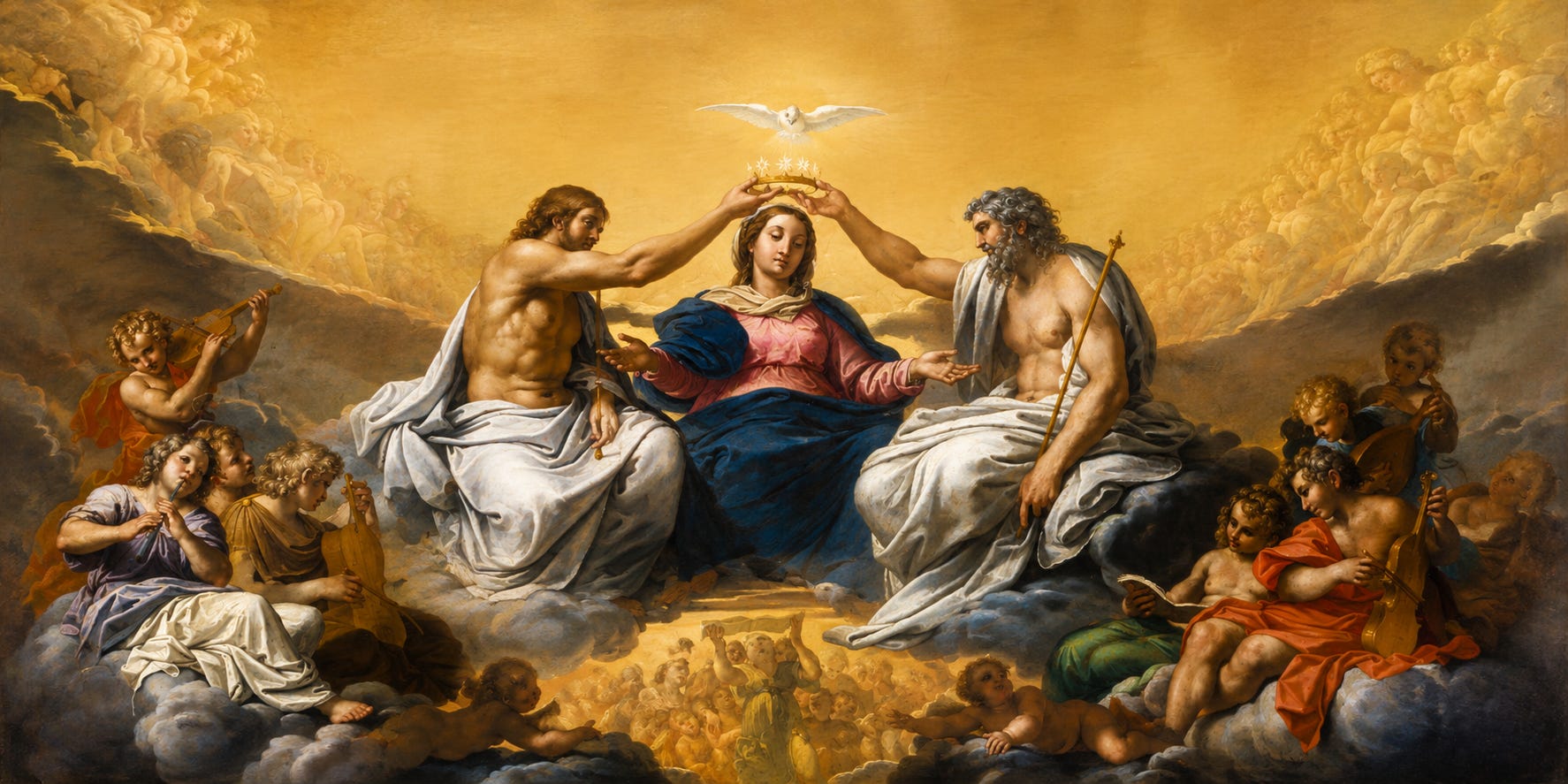
The Coronation of the Virgin — Annibale Carracci (1560–1609), c. 1595–1600.
Today the Church celebrates the Memorial of the Queenship of Mary, reminding us that the Mother of Jesus, the Queen of heaven, rules not through power but through humble faith.
This memorial was instituted by Pope Pius XII in 1954 through his encyclical Ad Caeli Reginam (“To the Queen of Heaven”). It was first celebrated on May 31, but Pope Paul VI later moved it to its current date, August 22, the octave of the Solemnity of the Assumption.
The Magnificat is one of the great gifts we have from Scripture. Below is a column from Fr. Ron Rolheiser on Mary’s prayer.
We invite you to join us at the end of the article to pray the Magnificat as a hymn with the Daily TV Mass Choir.
The Magnificat
By: Fr. Ron Rolheiser ©
A wise old Augustinian priest once shared this in class.
There are days in my life when everything from the pressures of my work, to tiredness, to depression, to distraction, to flat-out laziness make it difficult for me to pray. But, no matter what, I always try to pray at least one sincere, focused Our Father every day.
In the Gospels, Jesus leaves us the Lord’s Prayer, the Our Father. This is the most precious of all Christian prayers. However, the Gospels also leave us another precious Christian prayer, one that is not nearly as well known or practiced as is the Lord’s Prayer.
This is the prayer the Gospels place inside the mouth of Mary, the Mother of Jesus. Known as the Magnificat it is, for me, the most precious Christian prayer we have after the Lord’s Prayer.
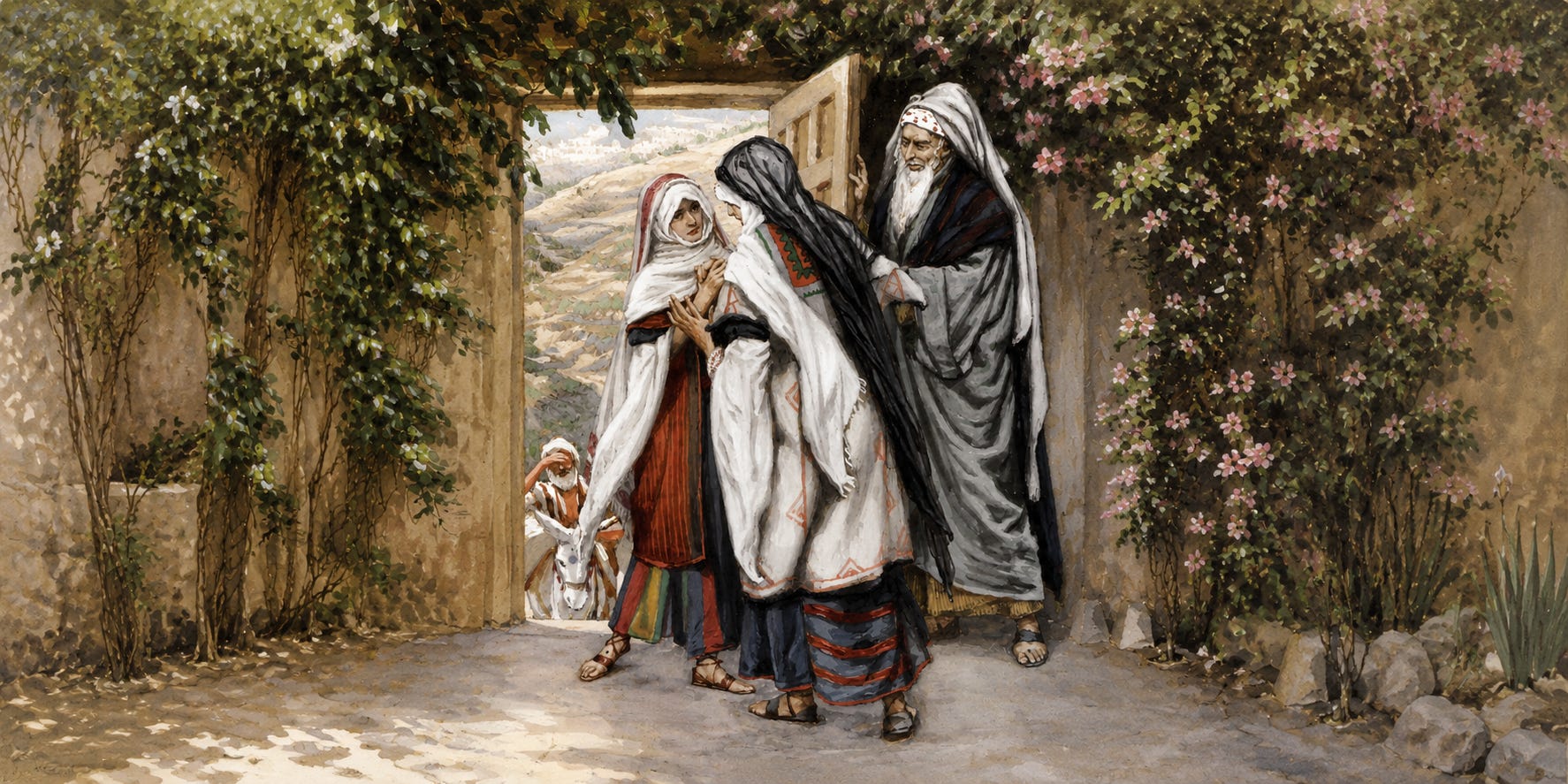
The Visitation of Mary and Elizabeth, inspired by James Tissot (1836–1902).
Mary’s Song of Hope
The Gospel of Luke paints the scene.
Mary, pregnant with Jesus, goes to visit her cousin, Elizabeth, who is pregnant with John the Baptist. Traditionally we call this “The Visitation” and what transpires between these two women is much more than what first meets the eye. This is no simple gender-reveal party.
Written more than eighty years after the event itself took place it is a post-resurrection reflection on the world-altering significance of what each of these women was carrying in her womb. As well, the words that they speak to each other also speak of a post-resurrection reality. It is in this context that the Gospels have Mary speak the words of the Magnificat.
What are those words?
They are words which thank and praise God for having taken the side of the poor, the humble, the hungry, and the oppressed in this world, having lifted them up and given them victory, even as he toppled the powerful off their thrones and humbled them. However, her prayer puts this all into the past tense, as if it was already an accomplished fact, already a reality in our world.
However, as the cartoon character, Ziggy, once reminded God in a prayer, “The poor are still getting clobbered down here!” For the large part, this seems so. Looking at our world, we see that the gap between rich and poor is widening, hundreds of millions of people go to bed hungry every night, corruption and crime are everywhere, and the powerful seemingly can simply take whatever they want without repercussions.
We have nearly one hundred million refugees on our borders around the world, and women and children are still victims of violence of all kinds everywhere.
Worse still, it would seem things are getting worse, not better.
So where do we see that God has hast cast down the mighty from their thrones, lifted up the lowly, filled the hungry with good things, and sent the rich away empty?
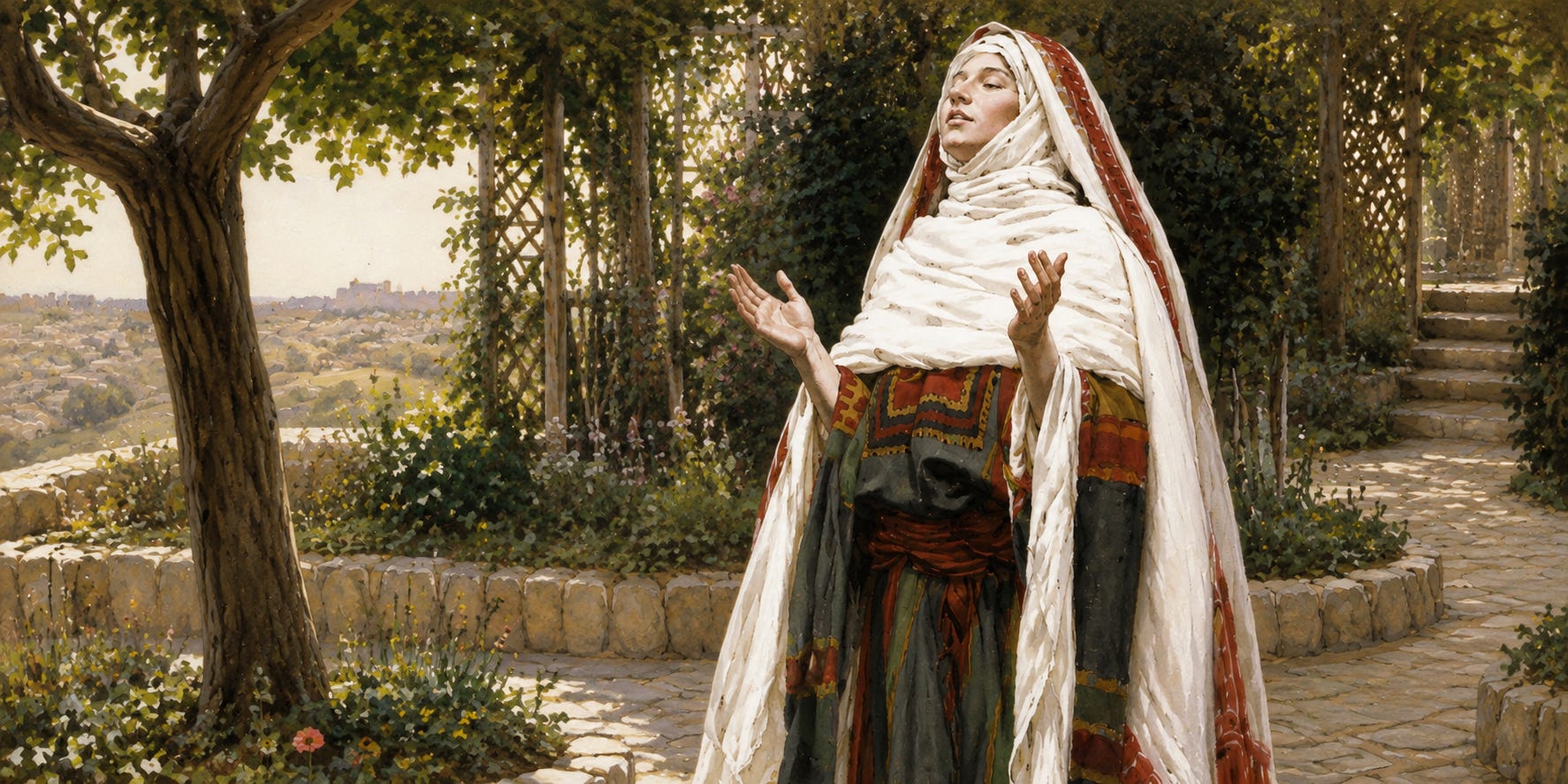
The Magnificat. Illustration inspired by the artistic style of James Tissot (1836–1902).
The Prayer of the Poor
We see it in the resurrection of Jesus and the vision of hope given us in that reality. What Mary affirms in the Magnificat is a deep truth we can only grasp in the faith and hope, namely, that even though at present injustice, corruption, and exploitation of the poor, seem to reign, there will be a last day when that oppressive stone will roll back from the tomb and the powerful will topple.
The Magnificat is the ultimate prayer of hope – and the ultimate prayer for the poor.
Maybe it is my age, maybe it is the discouragement I feel most evenings as I watch the news, or maybe it is both, but, as I grow older, two prayers (outside of the Eucharist) are most precious to me, The Lord’s Prayer and The Magnificat.
Like my old Augustinian mentor, I now make sure no day goes by where pressure, tiredness, distraction, or laziness keep me from praying at least two prayers with focus and attention, The Lord’s Prayer and the Magnificat.
That hasn’t always been the case.
For years, I looked at the Magnificat and saw there only the exultation of the Mary of piety, all the litanies and praises of Mary bunched into one. Not that there is anything wrong with that since the Mary of piety is someone to whom millions upon millions, not least the poor, turn to in need, seeking the guidance, comfort, and sympathy of a mother.
Few would argue against the goodness of this since it constitutes a rich mysticism of the poor, and of the poor in spirit.
However, the Magnificat is not so much about Mary’s personal exultation as it is about the exaltation of the poor. In this prayer, she gives voice to how God ultimately responds to the powerlessness and oppression of the poor. Henri Nouwen once wrote that watching the evening news and seeing the suffering in our world can leave us feeling depressed and powerless.
Depressed because of the injustice we see, powerless because it seems there is nothing we can do about it.
What can we do about it?
We can pray the Magnificat each day giving voice to how God ultimately responds to the powerlessness of the poor.
Pray with the Daily TV Mass Choir
As we celebrate the Feast of the Queenship of the Blessed Virgin Mary, we invite you to pray the Magnificat in a new way. This Advent hymn, written by Angelo Oddi and performed by members of the Daily TV Mass Choir, offers a quiet moment to listen, pray, and let Mary’s song of hope become your own.
Go in Peace —and Glorify the Lord by your Life.
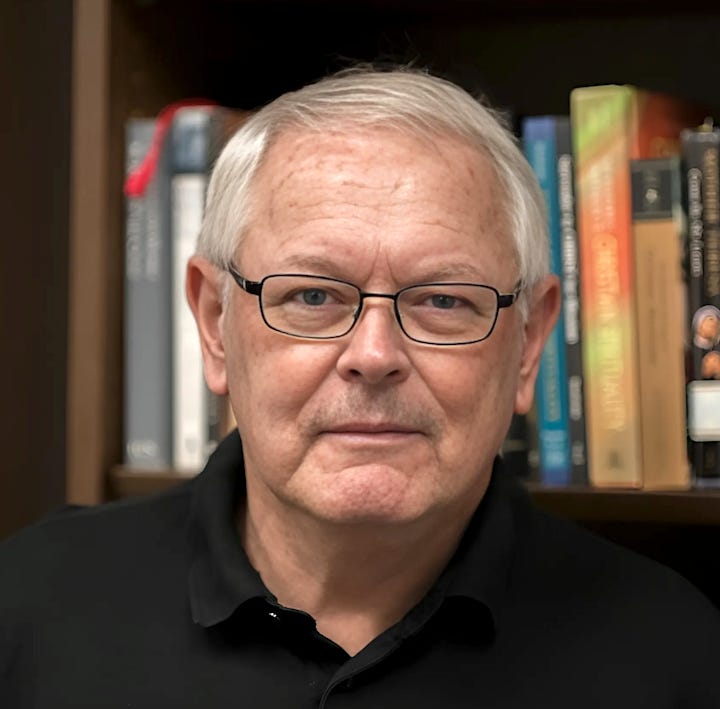
Fr. Ronald Rolheiser is a Roman Catholic priest and a member of the Missionary Oblates of Mary Immaculate (OMI). He is a founder of the Institute for the Study of Contemporary Spirituality at Oblate School of Theology, where he served as president for fifteen years and continues to serve as a full-time faculty member.
Fr Ron, Only Mother Mary and Elizabeth were at the scene. So who recorded what Mary said and what Elizabeth said? Very plausible, but there was no one else present! So who wrote it down? Who wrote the Magnificat?